Categories
(The 5 Key Principles)
Navigating Business Performance: An Intro to KPIs
Related Articles:
You cannot manage what you cannot measure!
Key Performance Indicators, also known as KPIs, are a fundamental component of good management. Going back to the basics, management is a decision-making job, and usually, a decision is as good as the information it is based on. Yes, it is true that in many situations, managers have to make decisions based on partial information, but the less data the decision-maker has, the higher the risk of making a poor decision. According to kpi.org, there are five types of KPIs.
According to kpi.org, there are five types of KPIs:
- Inputs measures (resources consumed in production)
- Process or activity measures (tasks)
- Outputs measures (results)
- Outcomes (more general results) and
- Project measures (the status of deliverables),
However, for the vast majority of use cases, this list can be simplified into three or even two categories:
- Inputs measures (used primarily in manufacturing where, for example, raw materials are used)
- Activity measures (used both in manufacturing and services)
- Outputs measures (used both in manufacturing and services)
Measuring inputs
KPIs that measure inputs are primarily used in manufacturing where organizations need to keep track of raw materials, parts, and components that go into production. Of course, these KPIs can also be used in the service industry, where hours or time spent on an activity is probably the most costly resource. In manufacturing, input KPIs are extremely valuable when trying to monitor waste or when comparing two competing parts that could be used in production (or the same part from two different vendors).
Measuring activities
When it comes to activities, process KPIs are used both in manufacturing and the service industry. For example, an organization could track the number of tasks performed by its employees. Even better, this measurement could go as granular as needed (the more granular, the better) to get a very clear picture. Imagine a call center. For such a group, it is essential to know how many tasks an agent performs in a specific timeframe. But what if the call center uses multiple communication channels like phone calls, emails, live chat, text messages, etc.? In such a scenario, knowing that an agent performs 15 tasks per hour is very important, but even more valuable is to know this number at the level of each communication channel.
- Not knowing how many tasks per hour an agent performs is terrible,
- Knowing that an agent performs, on average, 15 tasks per hour is better,
- Ideally, the manager would know that every hour an agent makes 4 phone calls, responds to 6 emails, and handles 5 live chats.
Why measure such detailed parameters? Because each activity requires a different level of effort and different resources. For example, after measuring each individual activity, one might discover that a phone call takes on average 5 minutes, while a chat might take 10 minutes. On the other hand, an agent can handle only one phone call at a time, while, when it comes to live chat, the agent can help 4 customers at the same time. In this situation, a manager would find out that an agent can take a maximum of 12 calls per hour (60 minutes / 5 minutes per call), but can be involved in 24 chats per hour (60 minutes / 10 minutes per chat x 4 simultaneous chats).
Does that sound like too much? Well, imagine now that the call center also handles multiple types of activities, for example, both customer support requests and customer complaints. If these activities are measured separately, one might discover that a complaint takes twice as much time to handle compared to a support request, therefore the analysis can go even deeper.
Measuring results (outputs)
Finally, KPIs are vital in measuring the outcomes. Continuing the example above, while productivity is measured by counting the number of activities in a given timeframe, efficiency measures positive outcomes compared to the number of activities that generated those results. As such, if the call center in our example also does sales work, it is important to know how many tasks, on average, were needed to sell a product or a service.
The use of KPIs
With all this information in hand, the data provided by the KPIs can be used in a multitude of ways:
- Goals settingIn order to succeed, people need goals, and KPIs can be used to establish those goals realistically. Unrealistic goals are more likely to hurt your efforts than to support them. Additionally, many organizational goals can be too generic for the workforce, which is why it’s important to break down those goals using KPIs.
- Resource managementIn resource management, the most important KPIs are the activity ones. Knowing how many activities are expected and how many activities an employee can realistically do (“employees are human too”), a manager can calculate the workforce required to get the job done. Please note that if the KPIs also reflect the time of day when an activity is done, the results could be surprising. While a factory might be able to produce at a constant rate throughout the day, a call center, for example, could see spikes in workload during lunchtime and in the evening when customers have more time available to handle their business. On the other hand, if the customers are businesses, the spikes could be seen in the first hours of the morning when people have more energy and then in late afternoon when many are trying to finish their work. Similarly, in manufacturing, one could see differences between a day shift and a night shift for multiple reasons, from the experience of different supervisors to metabolic changes between day and night (I would not be surprised to discover that during night shifts there is an increased rate of accidents).
- Process improvementI am a strong believer in working smart, but in order to achieve an optimal process, one needs to know what works and what doesn’t work. Are some types of activities more efficient than others (as determined by the count of positive outcomes vs. effort)? Then focus on those and try to eliminate or at least minimize the inefficient activities.
- Adjustments in TacticsThe Key Performance Indicators are the most valuable resources for adjustments in tactics. Because I am a fan of aviation, I always imagine the KPIs as all the indicators that a pilot sees in a cockpit. Some are just bulbs that turn on and off, others are detailed instruments showing all the specifics of a running engine, speed, altitude, heading, or angle of attack, but all those instruments together give the pilot the information required for decision making. Should you increase or decrease power? Should you change the flight level to avoid turbulence? Should you change the heading to avoid bad weather?
When does an organization have too many KPIs?
I will close this article with a natural question. Because in many organizations I have seen only a handful of KPIs, and because throughout this article I have advocated for capturing the deepest level of details, it is only natural to ask when many are too many. Fortunately, the answer is very easy: never. The more information an organization has, the more likely it is to make the right decisions.
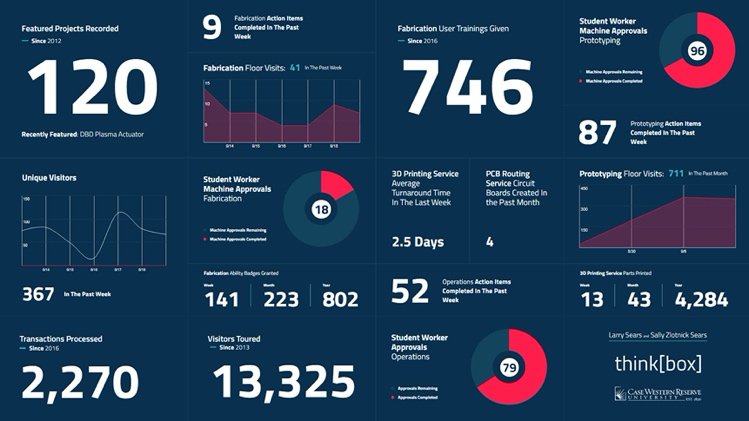
Now, of course, this does not mean that everyone should see everything at all times. While measuring everything that can be measured, organizations should aim to avoid overwhelming their employees with too much information, and dashboards should be adapted to the specific needs of each role. In general, the higher the role, the more data should be offered to the person in that position.
Unfortunately, finding the optimal sets of KPIs that keep the employees informed and motivated while avoiding overburdening them is more of an art than a science. One way to move towards a balance is to periodically adjust this information by interviewing the employees and finding what information is useful to them and what is not. Even more, this approach can open other doors into researching why certain data is found useful while others are not, which can hint towards how employees understand their roles, their goals, and the organizational goals.
Related Articles: